Read the wall before you spend a step
At a race in the Magaliesberg, the wall is often less about brute force and more about reading what is in front of you. Check the height, the top edge, the landing side and whether the ground is dry, loose or a bit muddy from an early shower. A quick look tells you where your feet can bite and where your hands will have the best grip.
If you can, watch one runner go over first. You are looking for the cleanest line, not the fastest-looking scramble. On some walls the best approach is straight on, on others a slight angle gives you a stronger push off one leg and less slipping. It is a small decision, but it saves energy over a long course.
The approach should feel like a set-up, not a sprint
Many runners waste strength by charging the wall too early. A better approach is controlled and short. Keep your chest up, eyes on the top edge, and take the last two or three steps with purpose. You want a strong plant, not a panicked jump.
Your final step should place you close enough to reach the top without stretching your shoulders too far. If you leap from too far out, your body swings away from the wall and your feet lose pressure. That is where calves burn and hands miss. Stay compact and let the wall work for you.
- Shorten your stride before the last step.
- Keep your hands ready, not hanging by your sides.
- Do not look at the ground once you commit.
Feet first, then hands, then hips
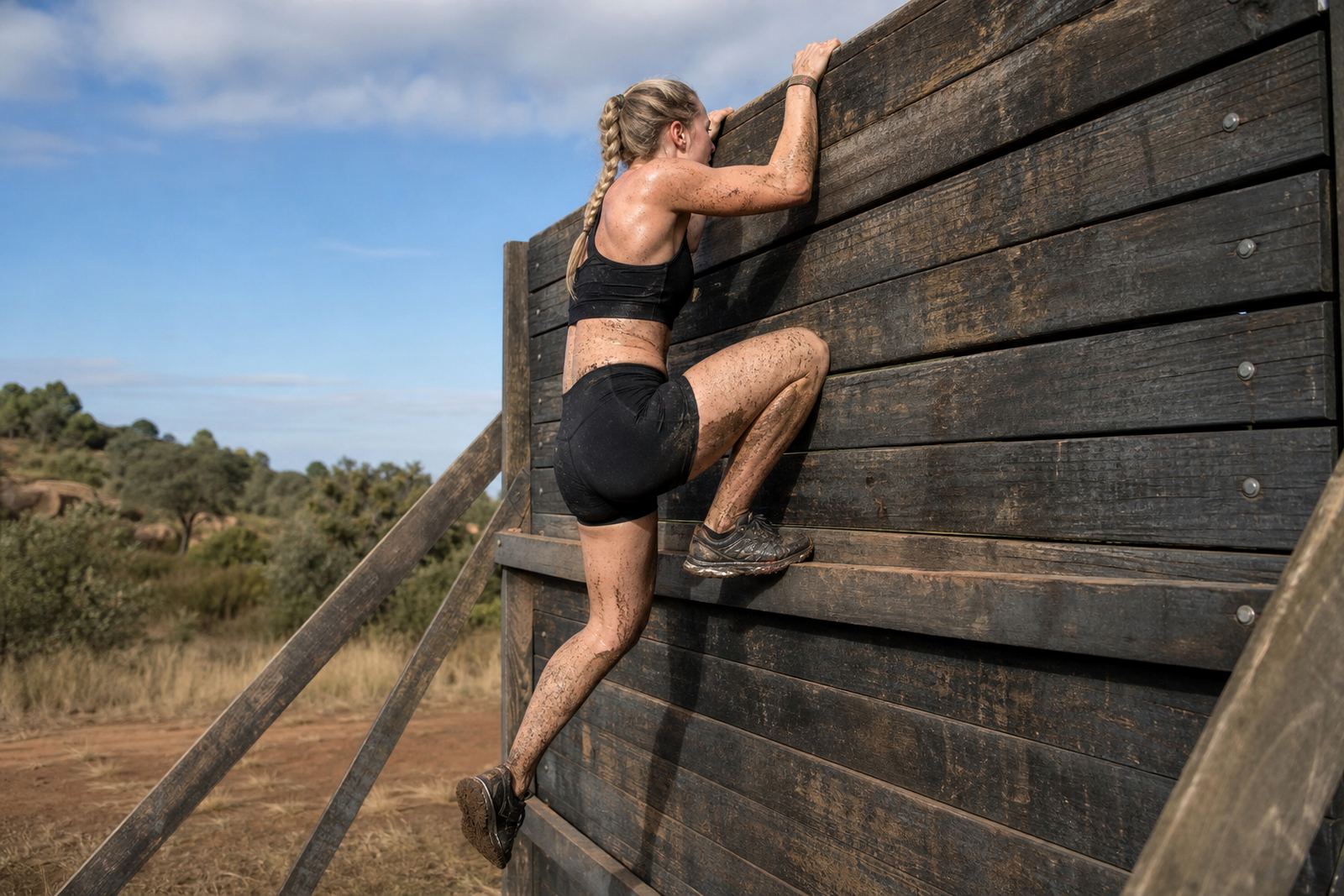
Good wall technique starts low. Place one foot firmly on the wall where the surface gives enough grip, then drive the other foot up if the wall allows it. At the same time, your hands should reach for the top edge with fingers secure and elbows slightly bent. That small bend helps you absorb movement instead of locking out and slipping.
From there, bring your hips up quickly. If your hips stay low, the wall becomes heavier. If your hips rise, your centre of mass moves closer to the top and the pull feels lighter. Think of climbing over, not pulling yourself like a rope. It sounds obvious, but under race pressure many people forget and use only arms.
In dry winter conditions around Hekpoort, dust can make the top edge slippery in an instant, so trust your feet and keep pressure through the wall. In wetter weather, the surface may feel softer but still unreliable, so test your grip before committing all the way.
Use the top edge without wasting grip strength
The top of the wall is where many runners lose time. They grab too hard, then their forearms lock up. Instead, grip firmly enough to hold your weight but not so hard that your arms shake. Once you are stable, bring one knee or one foot over, depending on the obstacle shape. A steady transfer is better than a wild kick.
If the wall has a narrow top, keep your elbows in and your shoulders close to the surface. If it has a broader lip, use that extra space to slide a hand and create a stronger pivot. Either way, avoid hanging on the edge longer than needed. You are moving over the obstacle, not staying on it.
For teams racing together, a clear call helps. One person should be ready to steady the base if the race rules allow it, while the runner at the wall stays focused on the movement itself. Good communication stops confusion when fatigue is already high.
Coming down safely saves more energy than a hero landing
The drop from the wall matters as much as the climb. If you leap without checking the landing, you may jar your knees or twist a foot on uneven ground. A controlled descent is usually faster over the whole race because you land ready to run instead of limping away from a bad impact.
Look for the landing area before you shift your full weight. If the ground is clear, step or lower yourself down with bent knees. If it is muddy or sloping, go slower and keep your body low. In the North West and Gauteng summer heat, people often rush the final drop because they are chasing shade or water, but that is when a small slip becomes a big one. Also, if you have any medical condition or past injury, check with a doctor before hard exercise and racing hard.
Pay attention to your breathing on the descent too. A controlled exhale helps calm the body before the next obstacle. You do not need to waste effort flailing away from the wall when a quiet stepdown will do the job.
Train the parts of the movement that matter most
Wall practice is not only about climbing. It is also about legs, grip, balance and body control. If you want less wasted energy on race day, train the movement in parts and then link it together. Step-ups, pull-throughs, squats and core work all help, but so does practising fast foot placement on a stable surface. Your aim is to make the movement feel ordinary even when your heart rate is high.
Before a race, do not arrive cold. A proper warmup should wake up your calves, hips, shoulders and grip. A few short explosive steps, some arm circles and a couple of controlled practice climbs can make a noticeable difference. It is not about showing off in the parking area, it is about telling your body what is coming next.
- Train step-ups on a box or tyre at different heights.
- Practice grip and shoulder stability.
- Work on balance when stepping down onto uneven ground.
- Use a short warmup that includes legs, hips and arms.
At Punisher events around Magaliesburg, Hekpoort and Hartbeespoort, wall sections can appear after hard running or before another strength obstacle. That is why efficient technique matters more than looking strong for one moment. The runner who stays calm usually has more left for the rest of the course, and that is often the difference between scraping through and moving well.